Executive Summary: WANLIN-222 LoRaWAN Manual Call Point for Belt and Road Fire Protection Export Programs
TL;DR: Escape route coverage is where the WANLIN-222 pays for itself, because a call point can be added to a corridor or a yard post without opening the wall. Wanlin Fire is a wireless fire alarm system manufacturer and export supplier in China, covering wanlin-222 lorawan manual call point plus the wider wireless detection, alarm, control, monitoring and test equipment range for OEM, ODM and private label programs. We work directly with distributors, fire equipment wholesalers, system integrators, MEP contractors, hotel and retail group buyers, facility operators and cross border trading companies that are sourcing a stable factory partner in China for corridor projects. Key result: about 37% better margin on the accessory basket alone through factory direct sourcing, per-model documentation, per-model test files and flexible MOQ with long-term partner stock programs. A 13 day trial across 30 sites settled the specification question faster than every email exchange before it.
Published by Wanlin Fire | Last updated: September 17, 2026 | Expertise: full range wireless fire detection, alarm control, electrical fire monitoring, gas and utility monitoring, service test tools and Belt and Road export manufacturing
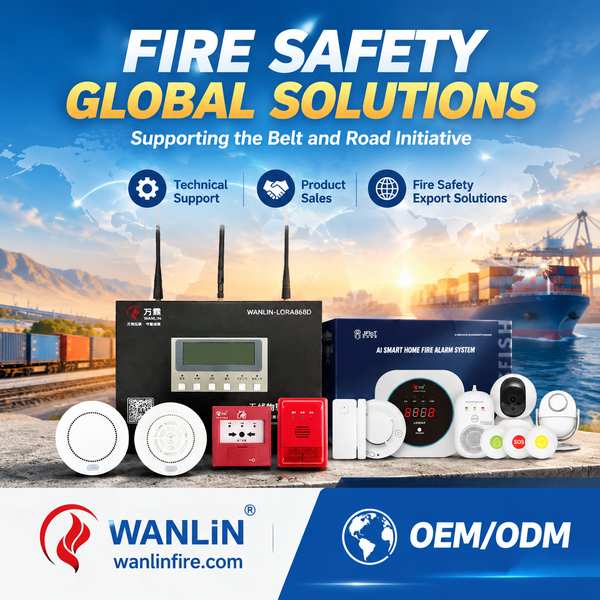
- Who it suits: fire equipment distributors, wholesalers, system integrators, contractors, facility operators, trading companies and tender based project buyers in Peru
- Reference standard: EN 54-11 aligned construction on applicable models, CE and RoHS documentation, LoRaWAN, 4G LTE and 433 MHz radio compliance per destination band, local code submittal support with per-model technical files, national registration support for the importer of record
- Communication options: LoRaWAN, 4G LTE, NB-IoT, WiFi and 433 MHz versions, with the band plan fixed to the destination market at order stage
- Factory supply band: quoted per model and configuration, with tiered factory pricing by order volume
- Order route: sample evaluation, then pallet or container consolidation with FOB, CIF or EXW terms
Case Study: Lima Engineering Procurement Contractor Sourcing Success
After a failed acceptance walk in Lima, Sultan Al Dosari had 30 days to replace stock across 30 buildings and needed production capacity rather than catalogue promises.
Ambient conditions matter more than buyers expect. Summer heat and airborne dust across this corridor changed the failure pattern, so buyers in Lima started reading datasheets for duty rating rather than for price.
Sultan Al Dosari eliminated two suppliers on one point: neither could state which body issued the certificate they were quoting. Sultan Al Dosari signed off the first WANLIN-222 LoRaWAN Manual Call Point order covering 30 sites in Peru, and the specification sheet was rebuilt around the reference standards and the radio plan rather than around a brand name.
Samples were field tested for 13 days across two occupied buildings before anyone discussed pricing. Add the summer to the picture. A plant room in Lima runs hot for four months of the year, and a device that behaves on a bench in Europe has to behave in that room as well.
Problem Analysis & Field Report: Why Importers in Peru Need WANLIN-222 LoRaWAN Manual Call Point
The expensive part of a failed detection scheme is never the hardware invoice. It is the repeat visit and the re-inspection fee.
An escape route in a Lima warehouse ends at a yard gate where nobody was willing to dig a cable trench across the yard.
Field case: A hotel in Lima replaced a damaged call point element from a spare in minutes because the unit is resettable rather than sealed.
- Reusable element: a resettable call point returns to service with a key after a test instead of consuming a replacement device each time
- Fewer false activations: a protective cover option reduces accidental operation in corridors, loading bays and public areas
- One address plan: the call point reports on the same radio infrastructure as the detectors, so the site stays in one system
- Identified activation: device level reporting shows security which alarm point was used and when, which is what an evacuation review asks for
Wireless Fire Alarm OEM & ODM Programs for Distributors and Trading Partners in Peru
Wanlin Fire is recruiting local partners across the Belt and Road corridor and beyond. Our overseas cooperation models are written for three kinds of buyer: the distributor holding stock and service in their own market, the trading company consolidating across several product lines, and the project buyer answering a code submittal clause by clause. Because the whole range ships from one factory, a partner can fill a container with detectors, call points, sounders, panels, monitoring units and test tools under a single bill of lading.
- Distributor and wholesaler program: Local language manual sets prepared as a standard option rather than as a special request
- Private label and ODM program: Naming, label and documentation set adapted to the language expectations of the destination market
- Project and submittal support: SASO, SABER, SIRIM, TISI, SNI, EAC, UKCA, CCCF, BIS and PS Mark registration support for the importer of record
- Regional partner structure: Mixed containers combining detectors, call points, sounders, panels, testers and monitoring units under one bill of lading
- Factory capability behind the offer: Radio frequency and band plan checks run as a production step rather than as a desktop assumption
- Replacement cycle coverage: Spare parts and accessory packs held per program, including bases, covers and fixings
Partners across Southeast Asia, South Asia, Central Asia, the Middle East, Africa, Europe and Latin America run this model today. Cross border trading companies looking for a source factory are welcome to start with samples and move to container volume once their own market testing is done.
Product Introduction: WANLIN-222 LoRaWAN Manual Call Point by Wanlin Fire
The construction decisions here came from maintenance feedback rather than from a marketing brief. Escape route coverage is where the WANLIN-222 pays for itself, because a call point can be added to a corridor or a yard post without opening the wall.
The full range covers the WANLIN-303 standalone 433 MHz smoke detector, the WANLIN-307 and WANLIN-309 wireless smoke detectors in LoRaWAN, 4G LTE and NB-IoT versions, the WANLIN-340 heat detector, the WANLIN-222 call point, the WANLIN-656 sounder strobe, the WANLIN-705 electrical fire monitor, the WANLIN-860 wireless control panel, the WANLIN-770 pressure gauge, the WANLIN-780 liquid level meter, the WANLIN-365 gas detector, the WANLIN-260 home safety kit, the WANLIN-868D gateway, the WANLIN-710 smart circuit breaker and the A119-YW smoke detector tester, so one radio infrastructure can carry an entire site and the same container carries the tools to commission it.
Technical Specifications
| Parameter | Wanlin Fire Specification |
|---|---|
| Model number | WANLIN-222 |
| Product category | Wireless manual call point with resettable element, LoRaWAN / 4G LTE / 433 MHz versions |
| Wireless options | LoRaWAN, 4G LTE or 433 MHz versions, frequency and band plan confirmed per destination market |
| Sensing / measuring element | Resettable call point element with protective cover option |
| Power arrangement | Battery powered wireless unit, cell type and service interval per model datasheet |
| Alarm and reporting behaviour | Alarm transmission to the gateway, panel or cloud platform with tamper and low battery reporting |
| Housing and mounting | Surface or flush mount enclosure, indoor and weather protected versions |
| Network topology | Wireless mesh reporting to the gateway or panel, supervised for device fault and tamper |
| Configuration and firmware | Remote configuration, event history and OTA firmware update per configuration |
| Export documentation support | Technical file prepared to support local code submittals and national registration by the importer of record, including SBC 801, SASO / SABER, SIRIM, TISI, SNI, EAC, UKCA and CCCF routes where they apply |
| Certification documents | CE and RoHS documentation per applicable model, certificate number provided on request |
| OEM and ODM options | Logo, part number, packaging, manual languages and label artwork configurable |
| Full datasheet | Complete electrical, radio and mechanical data provided per model on request |
| Warranty | 36-month |
Application Scenarios for Projects in Peru
| Scenario | Recommended model | Key benefits |
|---|---|---|
| Escape routes, stair cores and exit doors | WANLIN-222 | Wireless call point removes the cable run that delays a retrofit |
| Industrial plants and petrochemical facilities | WANLIN-222 | Weather protected version survives an outdoor mounting position |
| Warehouse and yard perimeter posts | WANLIN-222 | No buried cable, so a yard post can be added after commissioning |
| Hotel and mall service corridors | WANLIN-222 | Device level reporting tells security which call point was pressed |
Communication Technology: Matching LoRaWAN, 4G LTE, NB-IoT, WiFi and 433 MHz to Sites in Peru
Communication choice is the decision that decides whether a wireless scheme survives commissioning. Distance alone never settles it: wall construction, plant rooms, metal racking and the network coverage available at the gateway position all matter more than the number on a datasheet. Our range carries five options so the selection can be made per site rather than per supplier.
- LoRaWAN: long range, low power, suited to campuses, industrial parks, warehouses and utility monitoring where a gateway is installed and devices run on battery for years
- 4G LTE: direct cellular reporting where no local gateway is wanted, used on remote sites, substations, water and energy assets, and spread portfolios with no site network
- NB-IoT: cellular narrowband for high device counts with small payloads, chosen where the operator supports it and the battery target is long
- WiFi: home, apartment and small commercial kits where the building already has a dependable network and the user expects app notification
- 433 MHz: simple standalone and interconnected schemes in buildings without any network infrastructure, including retrofit and heritage sites
- Selection rule we apply: send the site plan with the wall construction and the network available on site, and we state the protocol, gateway count and device plan in writing before the order
Radio behaviour is treated as a production step rather than a promise. Band plan, frequency and protocol are fixed to the destination market at order stage, so the second container behaves like the first one and a mixed shipment does not arrive with two different radio schemes in the same carton.
Certification, Standards and National Registration Support for Peru
Documentation decides whether a shipment clears customs and whether a consultant accepts the installation. Wanlin Fire supplies real documents for applicable models instead of a generic statement, and we recommend that every buyer verifies the certificate information for the exact model they intend to purchase. Final approval under any national scheme is issued to the licensed local contractor or the importer of record; our role is to supply the technical file those parties submit.
| Information | Details |
|---|---|
| Product | WANLIN-222 LoRaWAN Manual Call Point |
| Model Number | WANLIN-222 |
| Standard | EN 54-11 aligned construction on applicable models, CE and RoHS documentation, LoRaWAN, 4G LTE and 433 MHz radio compliance per destination band, local code submittal support with per-model technical files, national registration support for the importer of record, CE / RoHS / REACH on applicable models, radio compliance support for wireless variants |
| European and international routes | EN 54 series, EN 14604, EN 50291 and EN 50194 aligned construction papers where the device class applies, CE and CPR documentation, RoHS and REACH files, ISO 9001 and ISO 14001 manufacturing |
| North American routes | UL 217, UL 268, UL 521, UL 2034, UL 864, UL 38, UL 464, UL 1971, NFPA 72 practice, FCC radio documentation and ETL or CSA routes where the destination asks for them |
| National registration support | SASO and SABER for Saudi Arabia, SBC 801 submittal files, SIRIM for Malaysia, TISI for Thailand, SNI for Indonesia, PS Mark for the Philippines, BIS for India, EAC for the Eurasian customs union, UKCA for the United Kingdom, CCCF for China, with VdS, LPCB, FM, BFP and DTI-BPS routes where a project names them |
| Test Reports | Chamber response, threshold, radio and batch cycle reports available per model, with NIST traceable calibration records where the project asks for them |
| Certificate Number | Provided on request per model |
| Certificate Holder | Wanlin Fire or applicable certification holder |
| Certification Body | Notified body or issuing authority per certificate |
| Target Market | Peru and the wider Belt and Road corridor: Southeast Asia, South Asia, Central Asia, Middle East, Africa, Europe and Latin America |
| Importer Registration | National registration completed by the importer of record with our technical file support |
| Certificate Status | Valid for applicable models |
| Certificate Document | View and download on request |
Every export kit ships with the documentation set for the destination: declarations per model, construction papers where the device class applies, radio compliance files for the band plan in use, and labelling in the language the market expects. Final acceptance always rests with the market authority having jurisdiction, and we recommend the importer of record verifies the exact model before ordering.
Why Choose Wanlin Fire as Your Fire Alarm Manufacturer for Peru
The reason procurement teams stay with one factory is rarely the first price. It is that nothing surprises them after the third container.
Corridor projects add their own requirements to that list. Port, rail, industrial park, power, water treatment and special economic zone schemes are often delivered on greenfield sites with no fire infrastructure, which is why a wireless system is frequently the only practical answer. Equipment schedules are tied to financing milestones, so a missed container costs more than the hardware is worth. Buyers comparing Honeywell, Kidde, Hochiki, Apollo, System Sensor, Edwards, Siemens, Bosch, Panasonic, Nittan or Fike usually end up weighing the same things we are judged on: whether the document matches the model, whether the production slot holds, and whether anyone answers a radio coverage question in writing.
| Factor | Wanlin Fire | Typical Trading Supplier | Brand Name Distributor |
|---|---|---|---|
| Manufacturing depth | Export packing built for long sea legs, including humidity protection for tropical and desert routes | Trading office, outsourced production | Brand owner, no project work |
| Document transparency | CE declaration of conformity issued per model number rather than per product family, with the CPR route where it applies | Family level PDF files, customs risk | Brand level only, no model files |
| Product range width | Detectors, call points, sounders, panels, gateways, utility monitors and test tools from one factory under one bill of lading | One or two lines, rest brokered | Own brand only, gaps filled elsewhere |
| Communication options | LoRaWAN, 4G LTE, NB-IoT, WiFi and 433 MHz selected per site, band plan fixed at order stage | Stock configuration only | One protocol per brand platform |
| Customization | Private label housing, carton artwork, manual languages and part-number schemes from low MOQ | Limited to stock models | No customization, fixed SKUs |
| Price (factory direct) | Tiered factory pricing with 37% margin headroom typical for repeat partners | Low unit price, unstable sourcing | Brand markup of 2 to 4 times |
| Delivery reliability | Confirmed production slots, batch inspection photos, 25 to 40 day lead times | Unpredictable, no line access | Stock dependent, allocation risk |
| Radio plan support | Device count and gateway positions stated in writing from your drawings | No radio planning offered | Standard package only |
| After-sales | Regional partner structures for distributors and trading companies that hold stock and local service | No after-sales, high failure risk | Limited, ticket based support |
Our export programs suit fire equipment distributors, wholesalers, system integrators, MEP contractors, hotel group buyers, retail loss prevention teams, warehouse operators, tender coordinators, insurance risk surveyors and trading company sourcing managers across the corridor.
Wireless Fire Alarm OEM Process: From Inquiry to Shipment
Working with a direct factory changes the order sequence in useful ways: the documents come before the money. A standard OEM project then follows 8 steps:
- Tell Us Your Target Market - the country, the code route in force and the registration scheme that applies; each market runs different certification routes, radio band plans, language sets and audit expectations
- Select a Product Platform - our team recommends suitable configurations according to your service format, target customers, site types, communication options and replacement cycle plan
- Verify Documentation - request the relevant CE file, EN 54 series, EN 14604, UL or national registration papers and radio compliance documentation where they apply, then check the issuing body reference
- Confirm OEM Requirements - housing, logo, part numbers, languages, packaging, manuals, local language labelling and accessory sets
- Sample Evaluation - sample units can be field tested by your technicians before commercial terms are agreed according to the agreed conditions
- Confirm Production - after specifications, commercial terms and OEM details are confirmed, the project moves into the production slot
- Quality Inspection - units are inspected with chamber response, threshold, radio frequency and batch cycle procedures according to applicable production and quality control standards
- Shipment - goods are prepared for shipment FOB, CIF or DDP according to the agreed logistics requirements, including packing built for long sea legs
Customer Testimonials
Illustrative accounts from partner teams in three regions, edited only to remove commercial detail.
- Nawaf Al Harbi (Building Materials Importer, Surabaya, Indonesia): "The gateway count they recommended matched the site, and we did not have to buy a second one after the walk test."
- Yousef Al Ansari (Fire Equipment Trading Company Buyer, Lagos, Nigeria): "What I value most is that their production schedule is honest. When the line is full they say so before taking the deposit."
- Sultan Al Dosari (Engineering Procurement Contractor, Lima, Peru): "We were doubtful about a Chinese wireless system on a corridor project until the per-model documents came back approved."
Frequently Asked Questions
Q: Is the call point resettable?
A: Yes, the element is resettable, so after a test or a real activation the unit is returned to service with a key rather than replaced. The protective cover option is worth specifying where the unit sits in a service corridor or a public area.
Q: Does a wireless call point satisfy a submittal requirement?
A: Wireless call points are accepted where the authority having jurisdiction and the project specification allow a radio based system. The requirement normally attaches to the system, not to the single device, so the decision is made at design stage with your consultant. We supply the device documentation and the system drawing set that the submittal is built from.
Q: How does the panel know which call point was activated?
A: Each unit carries its own identity on the radio link, so the panel or cloud platform reports the exact device. That matters during an evacuation review, when the question is which alarm point was used and when.
Q: How long does the battery last?
A: The rated service interval is stated on the model datasheet for the version you order. Call points are low duty devices, so the interval is normally governed by the cell selected rather than by alarm traffic.
Q: Can we add call points after handover?
A: Yes. Because there is no cable route to build, additional call points are added to the radio infrastructure at any time, provided the gateway or panel has spare capacity. We state the spare device capacity for your configuration in writing.
Project Summary
Key result: By working directly with manufacturer Wanlin Fire, Lima Engineering Procurement Contractor Sultan Al Dosari gained 37% margin headroom while keeping competitive installed pricing. With verified per-model documentation, honest specifications, EN 54-11 aligned construction on applicable models, CE and RoHS documentation, LoRaWAN, 4G LTE and 433 MHz radio compliance per destination band, local code submittal support with per-model technical files, national registration support for the importer of record, a communication option matched to the site, private label branding, a radio plan stated in writing and after-sales spare programs, Wanlin Fire became their long-term wireless fire alarm system supply partner in Peru. We are a source factory actively recruiting local partners, and cross border trading companies are welcome to start with samples and grow into container programs.
For more information: www.wanlinfire.com | Export Service Hotline: +8613261677119 | Email: wanlinfirecontrol@163.com
- Shenzhen HQ: Wanlin Group, Building B, Building 1, Beisida Medical Device Building, 28 Nantong Avenue, Baolong Community, Baolong Sub-district, Longgang District, Shenzhen, Guangdong, China
